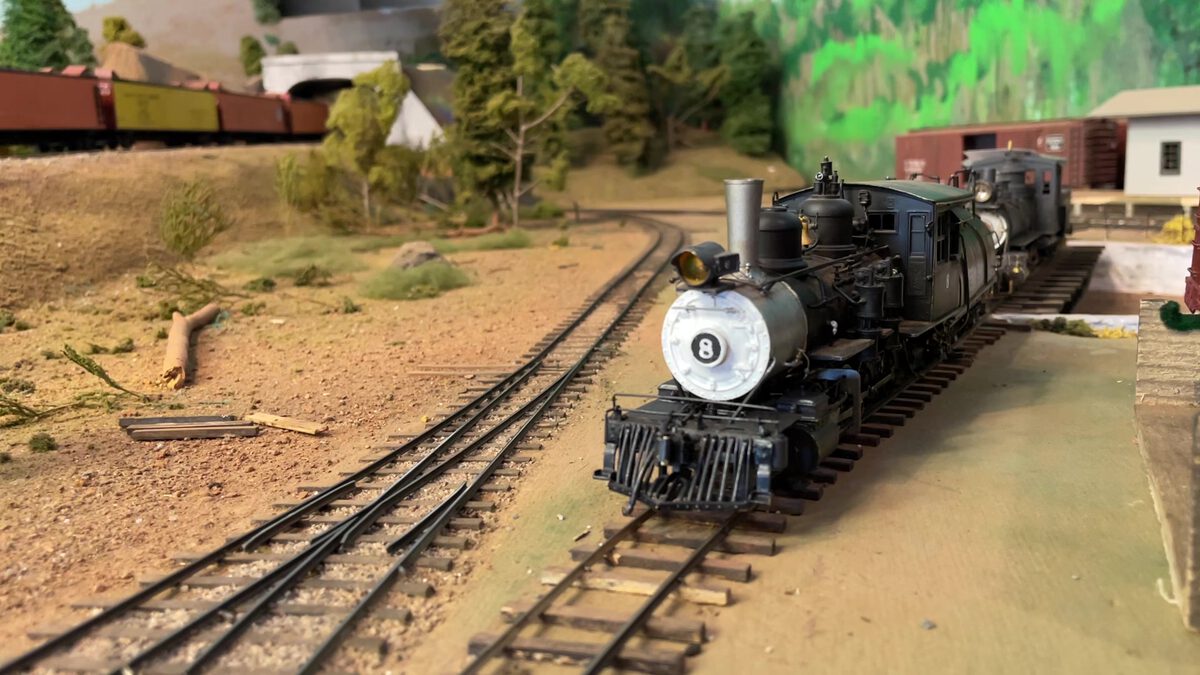
Trains of the Nevada County Narrow Gauge
From Colfax through Chicago Park and Grass Valley to Nevada City, the line carried freight, mail, and mining supplies for 66 years, and passengers for most of them.
From Colfax to Nevada City
The Nevada County Narrow Gauge Railroad ran from the Central Pacific depot at Colfax through Chicago Park and Grass Valley to Nevada City. Before the railroad, moving passengers and heavy mining equipment over county roads could take most of the day and became much harder in winter.
Construction began on February 11, 1875, and the last spike was driven on May 20, 1876. Over the next 66 years, the line carried freight, mail, and supplies between Nevada County and the mainline connection at Colfax. It carried passengers too, until that service was discontinued in December 1938; freight kept running until the last train in 1942.
The railroad earned the nickname "Never Come, Never Go," but its engine roster steadily grew. The first three locomotives were Baldwin wood burners, later additions came from other roads, and by 1916 all N.C.N.G. engines had been converted to oil.
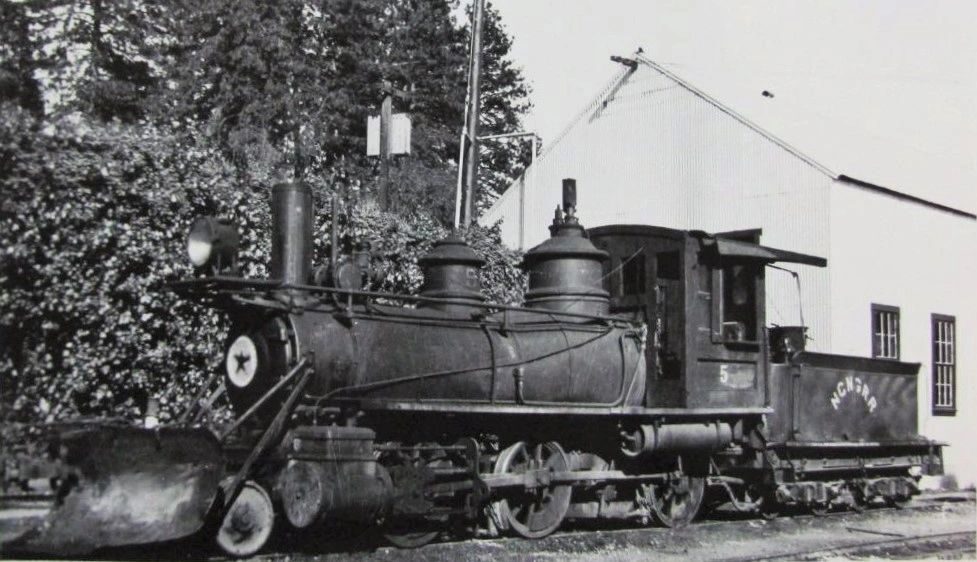
Original N.C.N.G. locomotive, circa 1900
Construction started
February 11, 1875
Last spike driven
May 20, 1876
Oil conversion complete
By 1916
Final steam addition
Engine #8 in 1933
Historical Locomotive Roster
Locomotives of the original Nevada County Narrow Gauge Railroad. This is not an inventory of the models or rolling stock currently on our layout.
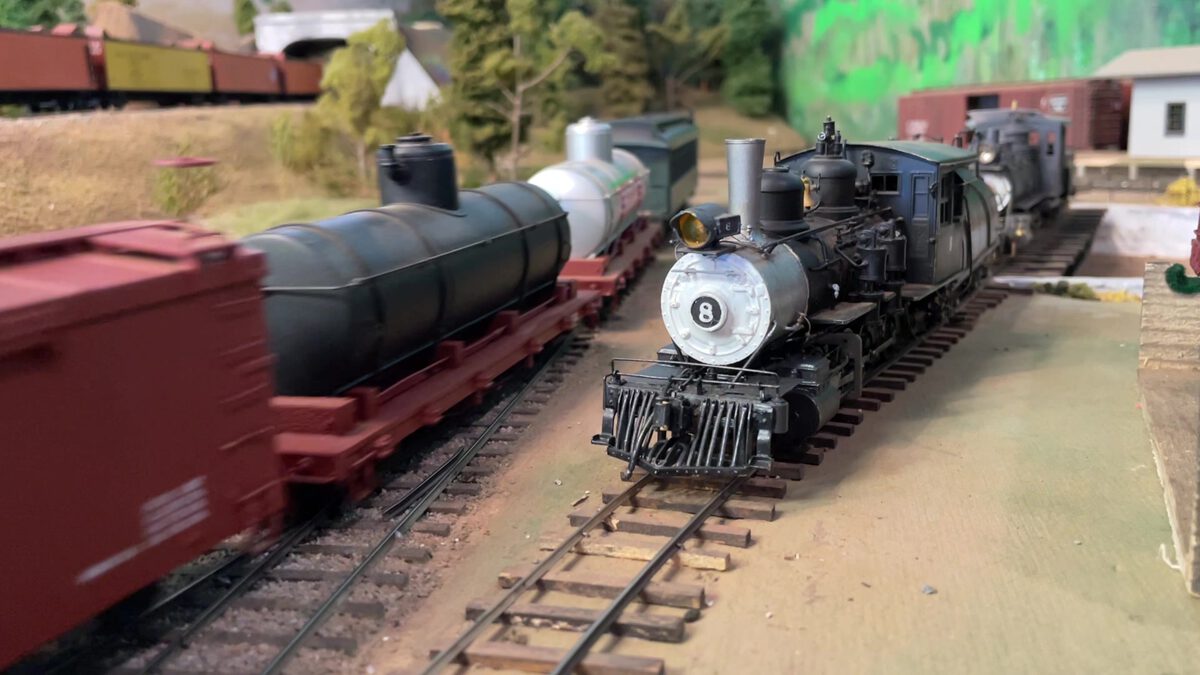
Engine #8 hauling a mixed freight consist
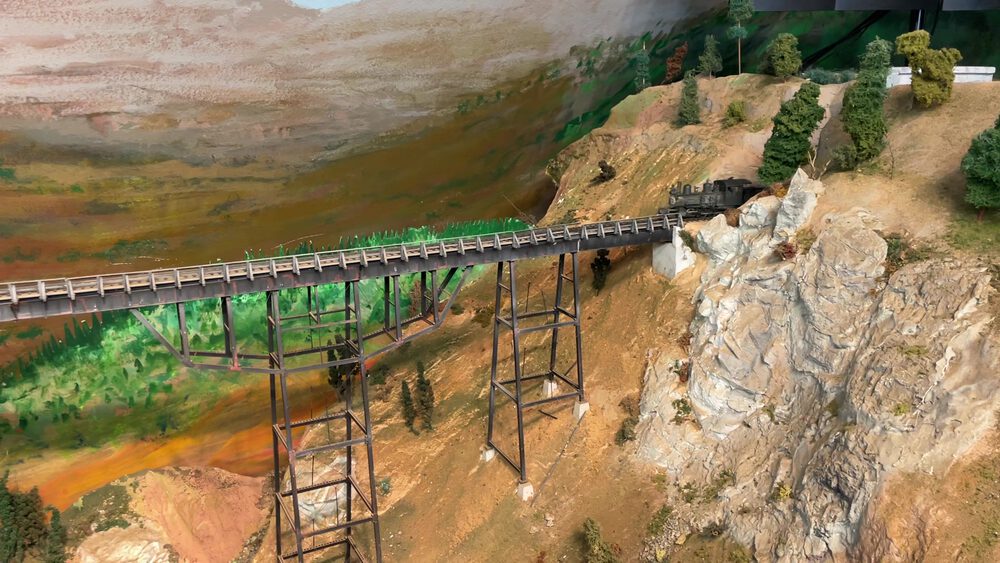
Engine approaching the trestle through the Sierra Nevada foothills
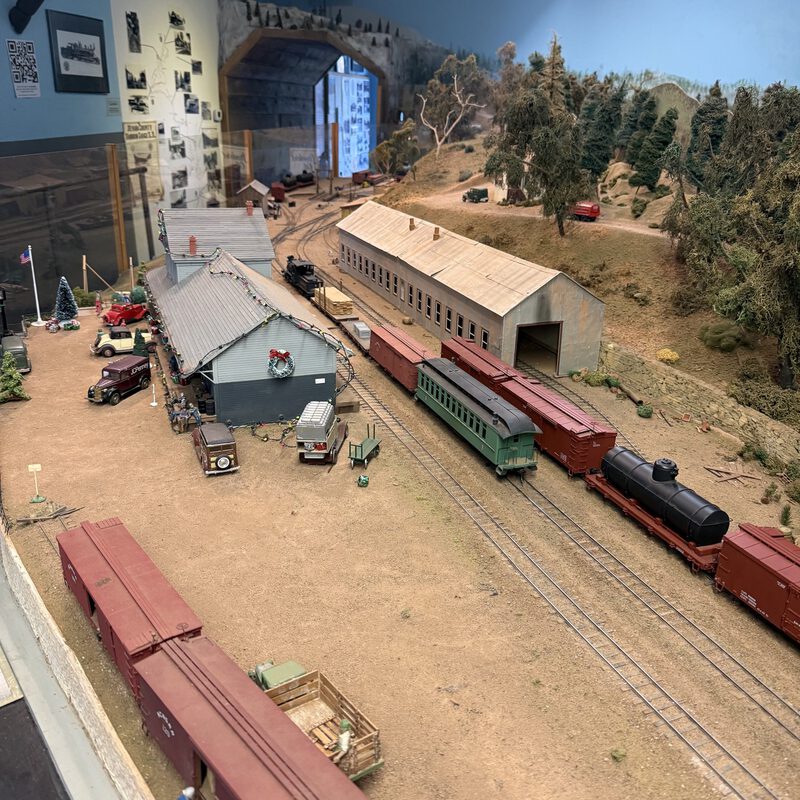
Grass Valley yard and engine house during the Christmas season
Original Baldwin engines
Engines #1, #2, and #3 formed the road's early Baldwin-built core.
Later acquisitions
Additional power came from the Lake Tahoe Railroad, Southern Pacific, and Denver & Rio Grande.
Fuel change
The first locomotives were wood burners, and all N.C.N.G. engines had been converted to oil by 1916.
Working railroad
The roster handled passenger service, freight, mining supplies, and interchange traffic at Colfax.
"Grass Valley"
- Builder / Previous Railroad: Baldwin Locomotive Co.
- Roster: Original roster
Original Baldwin wood burner named for Grass Valley; later converted to oil with the rest of the roster.
"Nevada"
- Builder / Previous Railroad: Baldwin Locomotive Co.
- Roster: Original roster
Original Baldwin wood burner named Nevada; part of the railroad's first locomotive group.
- Builder / Previous Railroad: Baldwin Locomotive Co.
- Roster: Added 1877
Added in 1877; a twin of #1 that never received a name.
- Builder / Previous Railroad: Lake Tahoe Railroad
- Roster: Added 1899
0-6-0 switcher acquired from the Lake Tahoe Railroad in 1899.
- Builder / Previous Railroad: Lake Tahoe Railroad
- Roster: Added 1899
2-6-0 acquired from the Lake Tahoe Railroad in 1899.
- Roster: Added 1915
2-6-0 added in 1915 as part of the later steam roster.
- Builder / Previous Railroad: Southern Pacific
- Roster: Later acquisition
4-4-0 acquired from Southern Pacific.
- Builder / Previous Railroad: Denver & Rio Grande
- Roster: Added 1933
2-8-0 brought over from the Denver & Rio Grande in 1933, giving the line heavier late-era freight power.
From NCO
Gas & Standard Gauge Power
The N.C.N.G. story also includes gas mechanical switchers and standard gauge power working out of Colfax.
The N.C.N.G. also rostered two gas mechanical switchers: #10, a 0-4-0 Plymouth acquired in 1936 and later wrecked, and #11, a 0-4-0 Whitcomb.
Standard gauge power appeared around 1913 on dual gauge track from Colfax to the Bear River gravel spur, where a two-truck Heisler and a two-truck Climax handled the work.
- #10 Plymouth - 0-4-0 gas mechanical, acquired in 1936
- #11 Whitcomb - 0-4-0 gas mechanical switcher
- Heisler and Climax - standard gauge power used on the Bear River gravel spur
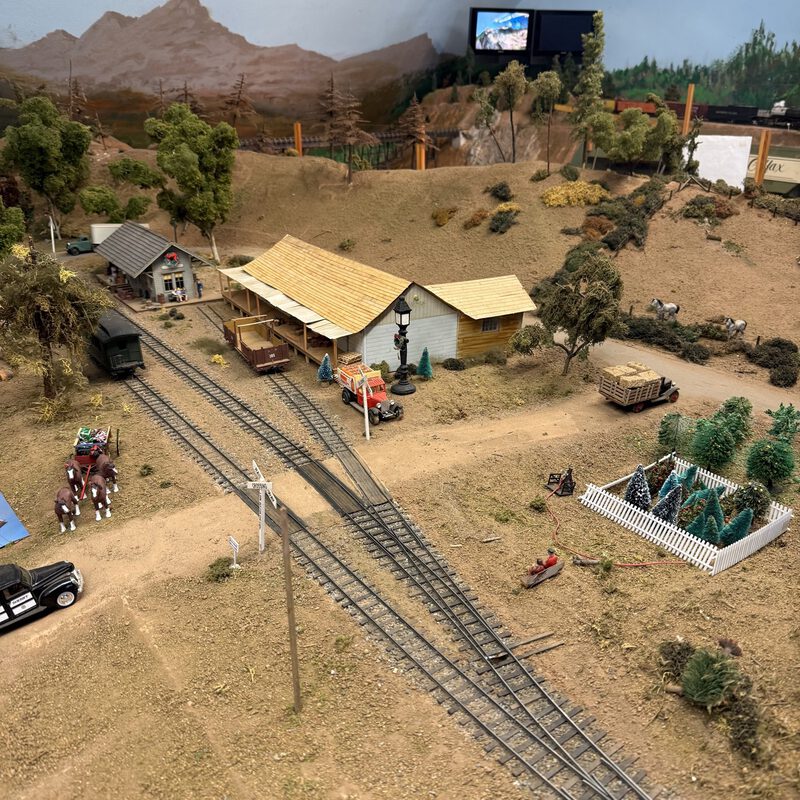
Colfax depot — railroad crossing, Christmas tree lot, and horse riders
Train Views on the Layout
A few of the train and line scenes that appear across the railroad.
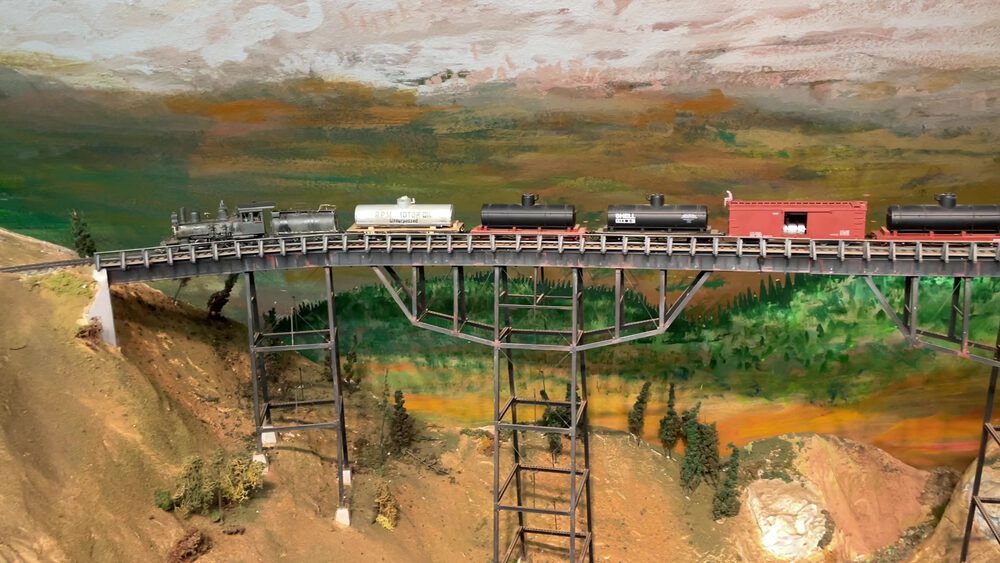
Full train on the Bear River Bridge — the signature piece of the layout
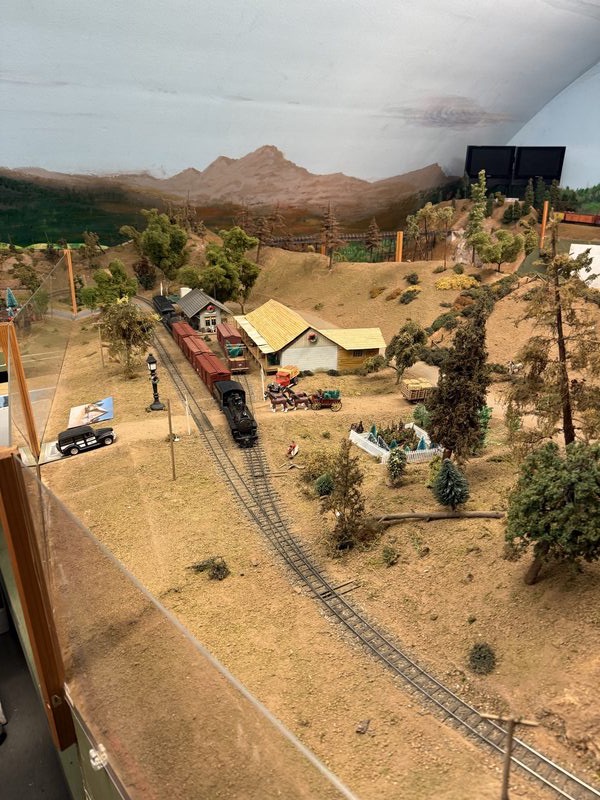
Steam locomotive passing through town with buildings and Sierra backdrop
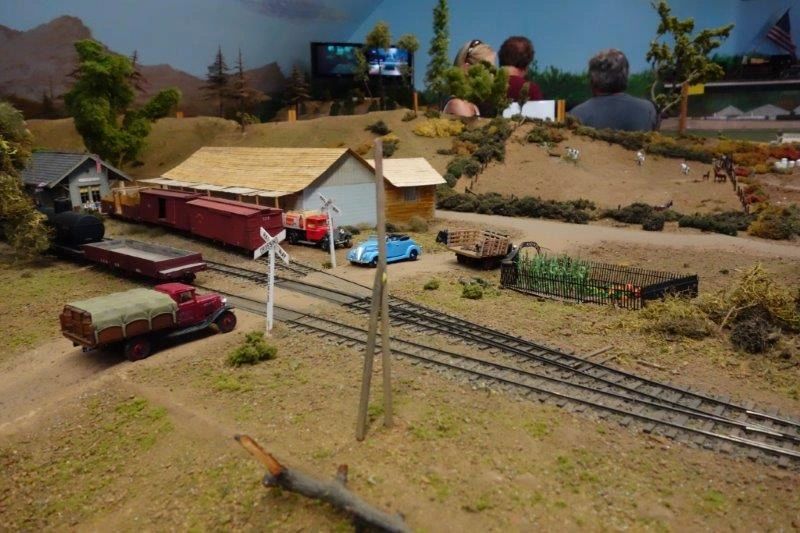
Rolling stock detail on the N.C.N.G. layout
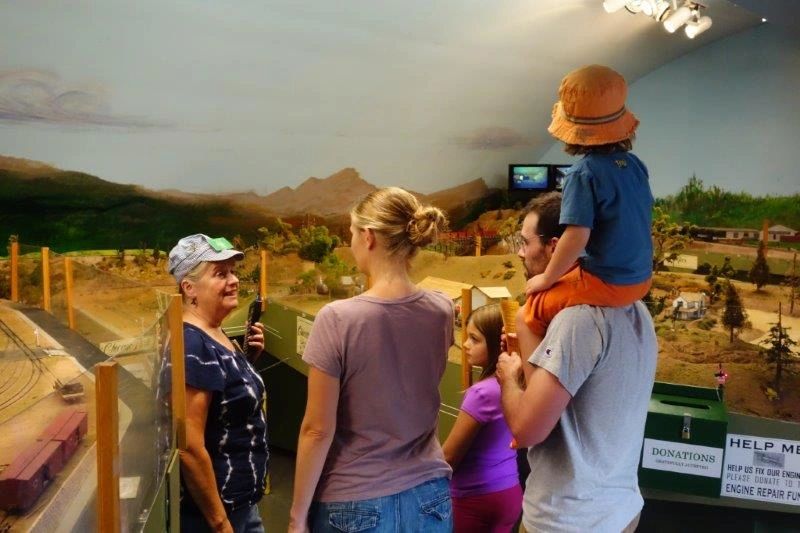
Visitors beside the model railroad, with town scenery and a painted mountain backdrop.